Why We Chose the Dunhuang Star Atlas
The Dunhuang manuscript's place in history and its visual order, with the original polar chart and an account of how the birth sky is divided, projected and drawn.
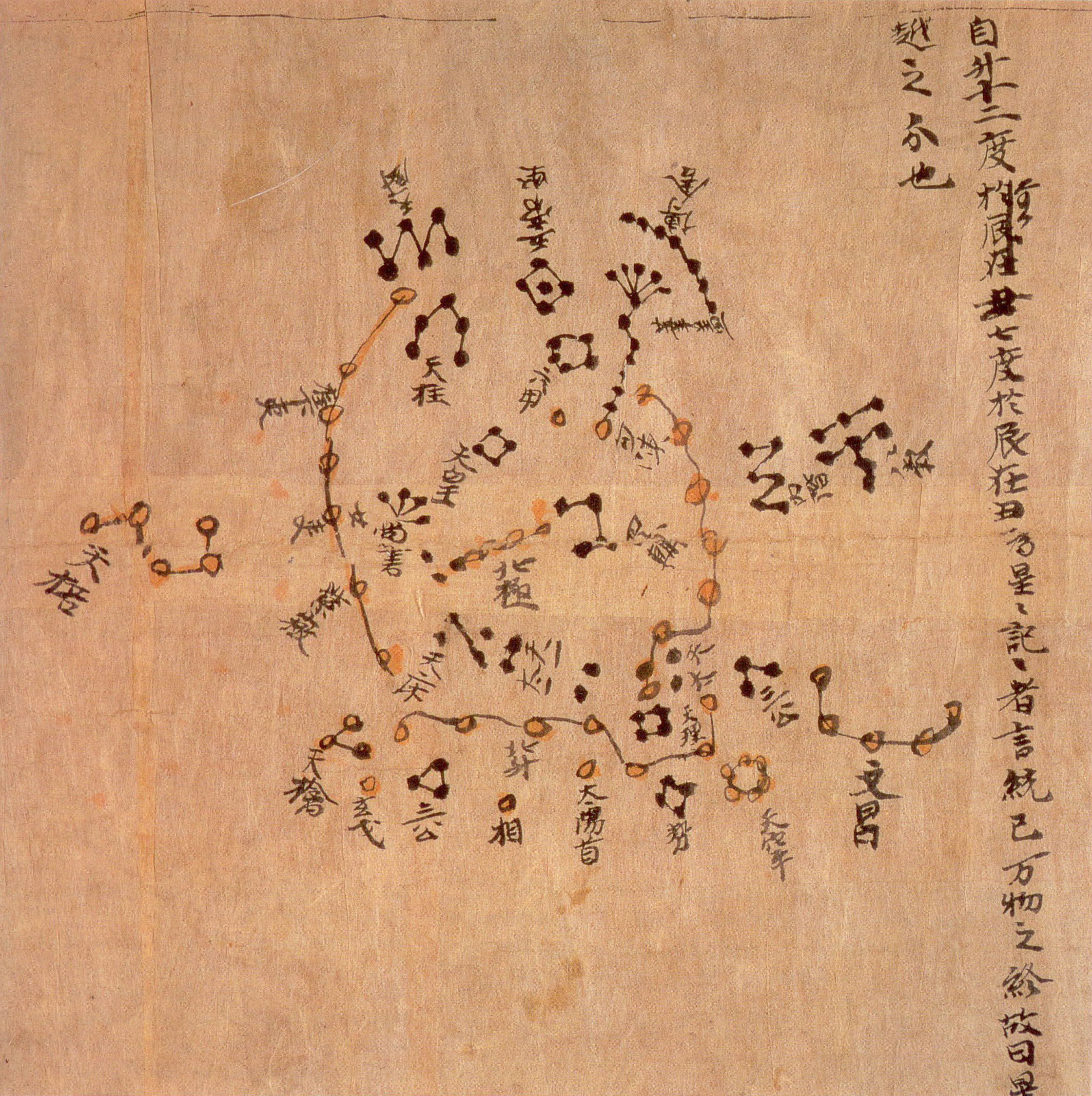
Among the manuscripts preserved in the Library Cave at Mogao, the Tang-period scroll now held by The British Library as Or.8210/S.3326 occupies an important place in the history of astronomy and Chinese cartography. Approximately 24.4 centimetres high and 3.3 metres long, it brings together illustrated cloud-divination material and a systematic atlas of the traditional Chinese sky. The British Library's collection introduction dates it to around 700 CE and identifies it as the oldest complete preserved star atlas.
The rediscovery of the Library Cave's documents in the early twentieth century brought the atlas into modern scholarship. Its paper, ink, points and inscriptions preserve the written form of Tang astronomical knowledge: how observers divided the sky, catalogued names and recorded their understanding on a scroll that could be kept and read. Solstice chose this reference for its historical standing and for a graphic language that remains clear across more than a millennium.

Bringing the celestial sphere onto paper
The Dunhuang atlas preserves an extensive sky in a coherent series of maps. Twelve sectional charts and a circular view centred on the north celestial pole contain more than 1,300 stars, with connections and Chinese asterism names. The pairing of sectional and polar charts shows how its makers approached the relationship between a three-dimensional sky and a flat sheet.
The 2009 quantitative study by Bonnet-Bidaud, Praderie and Whitfield examines positions, projections and dating. The sectional maps have approximately cylindrical characteristics, while the polar chart uses an azimuthal form. Their stellar positions can still be compared with modern records. This ink-drawn paper scroll provides physical evidence for the study of early astronomical mapping.
A visual order in paper and ink
Dots, lines and names give the atlas an abstract, ordered form. Points locate stars, fine lines connect them, and Chinese inscriptions identify the groups. Different colours preserve traces of the cataloguing traditions associated with Shi Shen, Gan De and Wu Xian. Names turn the relationships between points into knowledge that can be recognized, remembered and taught.
The traditional Chinese sky also gives celestial names to palaces, objects and officials. The polar region presents this order particularly clearly: the pole occupies the centre, with asterisms arranged around it, reflecting the court and society on Earth. The International Dunhuang Programme's introduction presents the names, charts and cultural setting.
As the scroll unfolds, the reader moves through successive regions and finally reaches the polar chart. Paper, ink and characters work together to support orientation and recognition, while the changing density of the drawing gives the sequence its visual rhythm. The atlas's historical value and beauty reside in these particular arrangements of writing and mapping.
A contemporary reference
Solstice's birth atlas borrows the Dunhuang atlas's visual and reading structure: a paper ground carries the points, ink lines connect groups, Chinese names support recognition, and sectional maps accompany a circular polar view. We chose it for its place in astronomical history and for the mature relationship between points, connections and names.
Our atlas brings that graphic language to a person's birth instant. Positions of the Sun, Moon, planets and stars are calculated from time and place, then drawn on sheets that can be explored individually. The scroll becomes a path through the sky: start with an overview, enter a region, and select a star to read its position and identity.
How the birth sky is drawn
Three belts and one polar chart. The original scroll has twelve sectional charts and one polar chart. Solstice uses three wider belts and a northern polar view for reading on a screen. Each belt spans 120° of right ascension; together they encircle the celestial sphere. The polar view separately presents the groups near the pole. Four charts sit together in the overview, while the region view enlarges their points, connections and names.
Right ascension and declination locate objects on the celestial sphere, serving as its longitude and latitude. The three belt titles state their right-ascension ranges, with representative groups listed beneath them.
| Chart | Declination range | Representative groups |
|---|---|---|
| Right ascension 0°–120° | −60° ≤ declination < +60° | Mao, Shen, Wuche |
| Right ascension 120°–240° | −60° ≤ declination < +60° | Xuanyuan, Yi, Jiao |
| Right ascension 240°–360° | −60° ≤ declination < +60° | Xin, Dou, Hegu |
| Northern polar sky | +45° ≤ declination ≤ +90° | Beidou, Beiji and nearby groups |
From sphere to drawing. On the belts, right ascension runs horizontally and declination vertically, both on linear scales. On the polar chart, right ascension sets the direction around the centre; angular distance from the north celestial pole sets the radius. Stars closer to the pole appear closer to the centre. The region between +45° and +60° declination connects the two views, with the same identity and coordinates retained for each repeated star.
Points, colours and connections. Vermilion highlights the Sun, Moon and five classical planets. Filled and hollow points distinguish objects above and below the birth location's geometric horizon; stellar point sizes are graded by catalogued brightness. Connections follow the members of the selected asterisms and are projected with the stars. Segments crossing a chart boundary are omitted there. Selecting a point reveals its name, modern identifier, right ascension, declination, local altitude and azimuth; selected stars also have naming notes.
Where positions, connections and names come from
Historical charts help us arrange the sky. Modern astronomical records provide positions for the birth instant, while asterism and naming records identify what appears in the drawing. Connecting these materials requires retaining each star's identity, the membership of its plotted groups and the provenance of its names.
Astronomy Engine calculates the positions of the Sun, Moon, Mercury, Venus, Mars, Jupiter and Saturn, with lunar phase evaluated at the same instant. The birth city and local clock time determine that instant and the objects' altitude and azimuth relative to the local horizon.
Most stellar positions come from Anderson and Francis's Extended Hipparcos Compilation, XHIP (2012), catalogued by CDS as V/137D. We select 340 HIP stars from the positions and magnitudes distributed by d3-celestial, alongside the existing mansion reference stars and three polar supplements; supplementary coordinates can be queried in SIMBAD. Directions start from J2000 coordinates and are transformed to the birth instant's equatorial frame. Catalogue identifiers keep a star recognizable as the same object across the belt and polar views.
The connections use 54 groups from Stellarium's Chinese sky-culture data. Two levels of provenance can be followed: the data records the HIP stars traversed by each path, while the accompanying notes and author credits explain its compilation. The notes identify Yi Shitong's Chinese and Western Contrast Star Chart and Catalogue 1950.0, star-catalogue volume, and Yixiang kaocheng as sources. The author credits trace Karrie Berglund's initial contribution to Hong Kong Space Museum maps and Sun Shuwei's expansion mainly to Yi's work, with further editing by the Stellarium team. Our atlas retains the selected paths and redraws them at modern positions.
That provenance also leads into Chinese sky culture. Asterisms organize named groups, while the Three Enclosures and Twenty-Eight Mansions provide larger structures. Palaces, offices, markets and everyday objects enter the names. The Hong Kong Space Museum's glossary of star regions, asterisms and names lists Liesi, Tusi and Bodu under the Heavenly Market, and Shangshu, Zhushi and Tianchu under the Purple Forbidden Enclosure. Such names connect the classification of the sky with social life, court institutions and material culture. The studies of the Han sky and the Suzhou chart listed below offer further ways to investigate those connections.
Individual stars are checked separately. The d3-celestial Chinese-name table supplies our base, linking names to positions through HIP identifiers. The Hong Kong Space Museum's bright-star glossary relates common Western names, modern constellation designations and Chinese names. Its introduction explains the asterism-plus-number naming pattern, and its entries retain multiple names where applicable. For example:
| Catalogue identity | Modern designation | Chinese names | Common Western name |
|---|---|---|---|
| HIP 53910 | β Ursae Majoris (β UMa) | 天璇、北斗二 | Merak |
| HIP 9884 | α Arietis (α Ari) | 娄宿三 | Hamal |
| HIP 25930 | δ Orionis (δ Ori) | 参宿三 | Mintaka |
Selecting Tianxuan therefore reveals its individual name, Northern Dipper grouping and modern designation together. The same cross-check corrected the displayed names of Lou III and Shen III. Group membership and individual-star numbering are recorded separately; paths that include neighbouring or subsidiary asterisms retain their source relationships, described in the card as a plotted group.
Further reading and corrections
These sources follow a path from manuscripts through catalogues and historical identification to the digital atlas. Each entry explains the part it supports.
The Dunhuang manuscript and its cartography. The International Dunhuang Programme introduction presents the scroll, its thirteen charts and colour classification. Bonnet-Bidaud, Praderie and Whitfield's The Dunhuang Chinese Sky: A Comprehensive Study of the Oldest Known Star Atlas, Journal of Astronomical History and Heritage 12 (2009), pp. 39–59, examines positions, projections and dating. The former introduces the object; the latter provides a quantitative research method to follow.
The direct source for plotted membership and connections. In Stellarium's Chinese sky-culture description, the Notes, References and Authors sections identify sources, bibliography and contributors. The line data resolves paths into individual stars: the Northern Dipper connects HIP 54061, 53910, 58001, 59774, 62956, 65378 and 67301 in sequence, allowing Tianxuan's place among the seven to be checked. This is the direct data layer used for our selection of 54 groups.
Historical catalogues and modern Chinese–Western identification. Yi Shitong, Chinese and Western Contrast Star Chart and Catalogue 1950.0, Science Press, 1981, two volumes, is an explicit source for Stellarium's compilation. Nathan Sivin's research guide recommends it for finding Chinese and Western equivalents and locating them on maps. Earlier in this documentary history, the Palace Museum's record of Yuding yixiang kaocheng describes the Qing catalogue's organization: volume 1 surveys the stars, volumes 2–13 give ecliptic coordinates, and volumes 14–25 give equatorial coordinates. The record shows how traditional names were preserved alongside systematic positions and helps explain the material organized by later comparison charts.
Historical scholarship on sky culture. Sun Xiaochun and Jacob Kistemaker, The Chinese Sky during the Han: Constellating Stars and Society, Brill, 1997, Sinica Leidensia 38. The publisher's preface and contents outline a reconstruction using the Shi Shi catalogue, the Shiji's Treatise on the Celestial Offices and other records. Chapter 3 addresses catalogue analysis and stellar identification; chapters 5 and 6 discuss celestial ideas, social imagery and major structures. It offers a route into the relationship between asterism names and human institutions.
The Suzhou chart and its accompanying text. W. Carl Rufus and Hsing-Chih Tien, The Soochow Astronomical Chart, University of Michigan Press, 1945, also appears in Stellarium's bibliography. The 1947 Nature book notice records its treatment of the engraved chart and explanatory text, including the equator, ecliptic, lunar path, Milky Way and court-related asterisms. It places points and connections alongside the cosmological text on the same artifact, providing a later comparison with the Dunhuang manuscript.
Cultural names and individual-star identities. The Hong Kong Space Museum's glossary of regions, asterisms and names follows structures such as the Three Enclosures and Twenty-Eight Mansions, supporting inquiry into names associated with institutions and objects. Its bright-star glossary lists modern designations, Chinese names, magnitudes and binary or variable flags by Western star name, supporting individual identification. d3-celestial supplies the HIP-linked base; the two museum tables complement it with cultural naming and stellar correspondences.
Please report mistaken names, membership assignments or citations, ideally with a catalogue entry, documentary edition or specific record, so we can check and correct the article. You can also return to the birth atlas, select a star and follow its name and identifier into the sources.
The asterism connections credit Karrie Berglund, Sun Shuwei and Stellarium contributors. Our selection of 54 groups retains CC BY-SA sharing; distributed stellar and naming material retains d3-celestial's provenance and BSD notice. Download the full credits and data-license notice; the original license is reproduced below.
Data credits and original BSD license
Copyright (c) 2015, Olaf Frohn
All rights reserved.

Redistribution and use in source and binary forms, with or without modification, are permitted provided that the following conditions are met:

1. Redistributions of source code must retain the above copyright notice, this list of conditions and the following disclaimer.

2. Redistributions in binary form must reproduce the above copyright notice, this list of conditions and the following disclaimer in the documentation and/or other materials provided with the distribution.

3. Neither the name of the copyright holder nor the names of its contributors may be used to endorse or promote products derived from this software without specific prior written permission.

THIS SOFTWARE IS PROVIDED BY THE COPYRIGHT HOLDERS AND CONTRIBUTORS "AS IS" AND ANY EXPRESS OR IMPLIED WARRANTIES, INCLUDING, BUT NOT LIMITED TO, THE IMPLIED WARRANTIES OF MERCHANTABILITY AND FITNESS FOR A PARTICULAR PURPOSE ARE DISCLAIMED. IN NO EVENT SHALL THE COPYRIGHT HOLDER OR CONTRIBUTORS BE LIABLE FOR ANY DIRECT, INDIRECT, INCIDENTAL, SPECIAL, EXEMPLARY, OR CONSEQUENTIAL DAMAGES (INCLUDING, BUT NOT LIMITED TO, PROCUREMENT OF SUBSTITUTE GOODS OR SERVICES; LOSS OF USE, DATA, OR PROFITS; OR BUSINESS INTERRUPTION) HOWEVER CAUSED AND ON ANY THEORY OF LIABILITY, WHETHER IN CONTRACT, STRICT LIABILITY, OR TORT (INCLUDING NEGLIGENCE OR OTHERWISE) ARISING IN ANY WAY OUT OF THE USE OF THIS SOFTWARE, EVEN IF ADVISED OF THE POSSIBILITY OF SUCH DAMAGE.